Use this comprehensive guide to job interview questions to confidently prepare for your upcoming interview. Use professional advice and sample responses to learn about common, behavioral, technical, and HR inquiries.
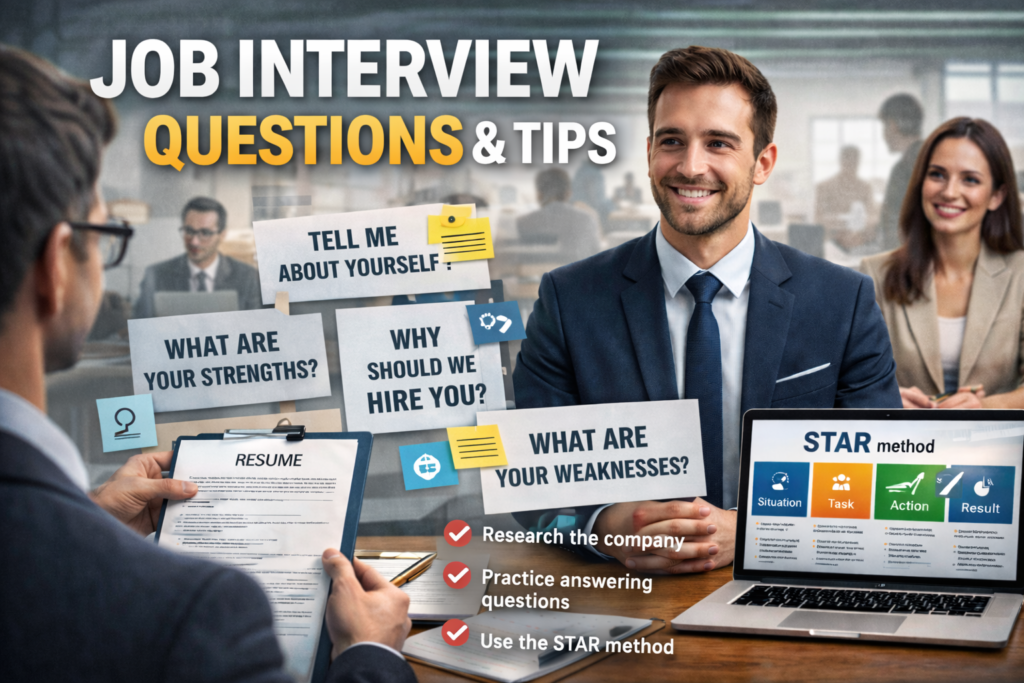
Introduction: The Importance of Getting Ready for Job Interview Questions
Interviews for jobs can be stressful, particularly if you don’t know what questions you might be asked. However, fear may be transformed into confidence with the right preparation. You can gain a competitive advantage and greatly improve your chances of success by being aware of typical interview questions and preparing your answers.
Employers evaluate a candidate’s communication, problem-solving, attitude, and cultural fit in addition to technical competence. The most often asked interview questions, astute response techniques, and examples relevant to your business will all be covered in this extensive guide.and useful advice to help you provide your best effort.
Whether you’re a recent graduate, seasoned professional, or changing careers, knowing how to answer interview questions is crucial to getting your ideal position.
H2: Different Kinds of Interview Questions
In general, interview questions fall into a number of categories. Understanding these sorts enables you to formulate well-organized and assured answers.
H3: Questions for a General Interview
These are simple inquiries meant to delve into your motivations, history, and personality.
Typical instances:
- Describe yourself to me.
- What makes you want this position?
- How much do you know about our business?
- What are your advantages and disadvantages?
How to respond:
- Answers should be succinct and pertinent.
- Match your abilities to the demands of the position.
- Steer clear of too much personal information.
Suggestion for an Internal Link:
Learn how to introduce yourself at a job interview by reading our article.
H3: Questions for Behavioral Interviews
In order to forecast future behavior, behavioral inquiries examine how you have responded to previous circumstances.
Well-known instances:
- Describe a situation where you overcame a challenge.
- Tell us about a difficult circumstance you faced at work and how you resolved it.
- Give a collaborative example.
The STAR approach is the best way to respond.
- The circumstances
- Task Action Outcome
- This approach guarantees well-organized, understandable, and persuasive responses.
H3: Questions for Technical Interviews
Particularly in the areas of IT, engineering, finance, healthcare, and skilled professions, these questions assess knowledge and abilities relevant to the work.
For instance:
- Describe the concepts of OOP.
- Financial forecasting: what is it?
- How may system issues be troubleshooted?
Advice for preparation:
- Examine the tools appropriate to your profession.
- Practice situations from the real world.
- Review the technological basics.
Outside Source:Visit https://www.geeksforgeeks.org for technical interview preparation advice
H3: Situational Interview Questions
The focus of situational inquiries is on speculative situations.
For instance:
- If you couldn’t fulfill a deadline, how would you respond?
- How would you respond to a challenging client?
- Employers use these questions to evaluate a candidate’s capacity for ethical behavior, problem-solving, and decision-making.
H2: Frequently Asked Questions for Job Interviews and Examples of Responses
H3: 1. Describe Yourself
How to respond:
Emphasize your accomplishments, professional history, and career objectives.
Example Response: “I have worked in operations management and customer service for five years. Increasing client happiness and optimizing workflows are my areas of expertise. I’m currently looking for a chance to use my expertise and advance my career.”
H3: 2. What Makes You a Good Hire?
How to respond:
Emphasize your accomplishments, abilities, and fit with the company’s objectives.
Example Response: “I contribute solid analytical abilities, collaboration, and track records of success. My background is ideal for what you need, and I’m excited to help your business succeed.”
H3: 3. What Do You Have to Offer?
Advice:
Choose two or three strengths.
Give instances to back them up.
Associated with the job role
Sample Answer:
“My key strengths include communication, adaptability, and problem-solving, which help me perform well in dynamic environments.”
H3: 4. What Weaknesses Do You Have?
Approach:
- Be truthful.
- Select a non-critical flaw.
- Make progress
Sample Answer:
“I used to struggle with delegation, but I’ve learned to trust team members, which improved productivity and teamwork.”
H3: 5. In five years, where do you see yourself?
Companies want to know if you’re dedicated and goal-oriented.
Sample Answer:
“In five years, I aim to develop leadership skills, contribute to strategic projects, and grow within the organization.”
H2: Sample Responses to Behavioral Job Interview Questions
H3: Managing Disagreement
Question: Tell us about a disagreement you had at work and how you handled it.
Sample Answer:
“I listened carefully, encouraged open communication, and found a compromise that improved collaboration.”
H3: An Illustration of Leadership
Question: Provide a leadership example.
Sample Answer:
“I led a project team of five, coordinated tasks, and completed the project ahead of schedule, improving efficiency by 20%.”
H2: Industry-specific Technical Job Interview Questions for IT and Software Development
Cloud computing: what is it?
- Describe RESTful APIs.
- Database normalization: what is it?
Accounting and Finance
- Describe financial statements.
- Budgeting: What is it?
- Explain risk management.
Sales and Marketing
- SEO: What is it?
- Describe conversion funnels.
- How are leads generated?
H2: Astute Interview Questions to Pose
Posing meaningful queries demonstrates excitement and interest.
Excellent instances:
- What constitutes success in this position?
- What are the prospects for growth?
- How is the performance of employees assessed?
- What difficulties does this squad encounter?
H2: Job Interview Preparation Checklist:
Before the interview, research the company, review the job description, prepare examples, practice mock interviews, dress professionally, arrive early, bring extra resumes, maintain positive body language, reflect on performance, and politely follow up.
H2: Common Job Interview Mistakes to Avoid:
ate, not researching the company, talking negatively about previous employers, giving vague answers, and not making eye contact. Avoiding these mistakes immediately improves interview success.
H2: Questions and Advice for Virtual Job Interviews
The use of remote interviews is growing in popularity.
Typical Questions for Virtual Interviews
- How do you manage to remain productive when working from home?
- How do you handle virtual communication?
Tips for Virtual Interviews
- Check your microphone and camera.
- Select a peaceful setting.
- Wear business attire.
- Keep your eyes open.
External Source: Indeed’s virtual interview guidance may be found at https://www.indeed.com/career-help/interviewing
H2: Questions and Advice for Virtual Job Interviews
The use of remote interviews is growing in popularity.
Typical Questions for Virtual Interviews
- How do you manage to remain productive when working from home?
- How do you handle virtual communication?
Tips for Virtual Interviews
- Check your microphone and camera.
- Select a peaceful setting.
- Wear business attire.
- Keep your eyes open.
External Source: Indeed’s virtual interview guidance may be found at https://www.indeed.com/career-help/interviewing
H2: Interview Questions for New Graduates
Typical Questions for Beginners
- Describe your academic endeavors to me.
- Describe a difficult situation you overcome.
- Why should we bring on a new employee?
Advice: Pay attention to abilities, zeal, flexibility, and a growth mentality.
H2: Using the STAR Method to Craft Powerful Interview Responses
The STAR technique works quite well:
- Situation: Explain the background
- Assignment: Describe accountability
- Action: Discuss the actions that were taken.
- Result: Emphasize the result
This approach increases impact, clarity, and storytelling.
- H2: Common Questions and Answers (FAQs)
- Q1: How many questions should I prepare for the interview?
Prepare a minimum of 30 to 40 standard interview questions.
Q2: What is the ideal length for my responses?
Keep your focus and clarity intact and aim for one to two minutes every response.
Q3: Should I commit the answers to memory?
No, practice organically rather than by memorization.
- In conclusion, learn how to ace job interviews so you can land your ideal position.
One of the most crucial elements to a successful career is preparing for interview questions. You can make the most of interviews if you have the proper approach, confidence, and practice.
Your success rate can be significantly increased by comprehending the various question types, crafting compelling responses, steering clear of typical blunders, and projecting a professional image. Keep in mind that interviews are discussions where both parties assess compatibility, not interrogations. You’ll be ready to crush your next job interview and get closer to your professional goals if you follow this strategy, practice frequently, and maintain your confidence.